Drag pressure flow
→ Graphical representation of the drag pressure flow
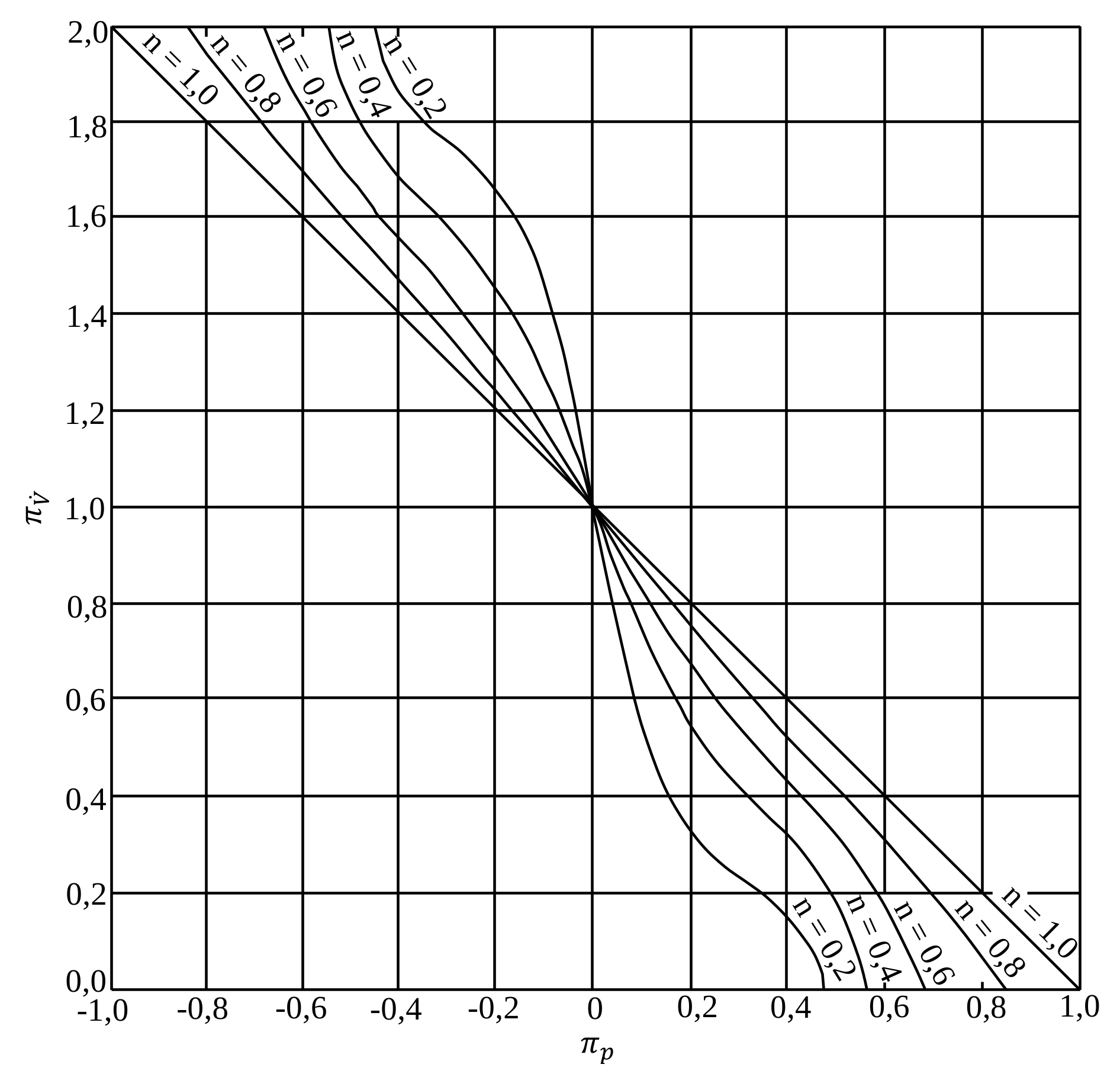
The dimensionless flow rate $π_{\dot m}$ describes the actual mass flow in relation to the mass flow caused by the drag flow. In the one-dimensional case, neglecting all boundary influences, a $π_{\dot m} = 1$ therefore means that there is a pure drag flow.
The dimensionless flow rate is defined as follows:
$$π_{\dot m} = \frac{2 \cdot \dot m}{ρ \cdot i \cdot h \cdot b \cdot v_{0z}}$$ $$\text{with}$$ $$v_{0z}=v_0 \cdot cos(\varphi)=\pi \cdot N \cdot D \cdot cos(\varphi)$$ $$\text{and}$$ $$tan(\varphi)=\frac{t}{\pi D}$$
with the mass flow rate $\dot m$, the density $\rho$, the number of turns $i$, the channel height $h$, the channel width $b$, the cylinder speed in the channel direction $v_{0z}$, the rotational speed $N$, the nominal diameter $D$, the pitch angle $\varphi$ and the pitch $t$.
The dimensionless pressure gradient $\pi_p$ describes the influence of the pressure gradients on the overall flow. This value therefore describes the mass flow of a pressurised flow. A value of 0 therefore means that there is no pressurised flow and thus a pure drag flow. A value of 1, on the other hand, means that the pressure gradient results in a pressurised flow that is identical in size to the drag flow. In this case, the resulting mass flow rate is 0. The dimensionless pressure gradient is defined as follows
$$\pi_p = \frac{h^{1+n}}{6 \cdot K \cdot v_{0z}^n} \frac{\Delta p}{Z}$$
with the channel depth $h$, the flow_law_exponent $n$, the consistency_factor $K$, the cylinder velocity in the channel direction $v_{0z}$ and the pressure difference $\Delta p$ on the channel length $Z$.
The following applies to the one-dimensional case described so far:
$$\pi_\dot m = 1 - \pi_p$$
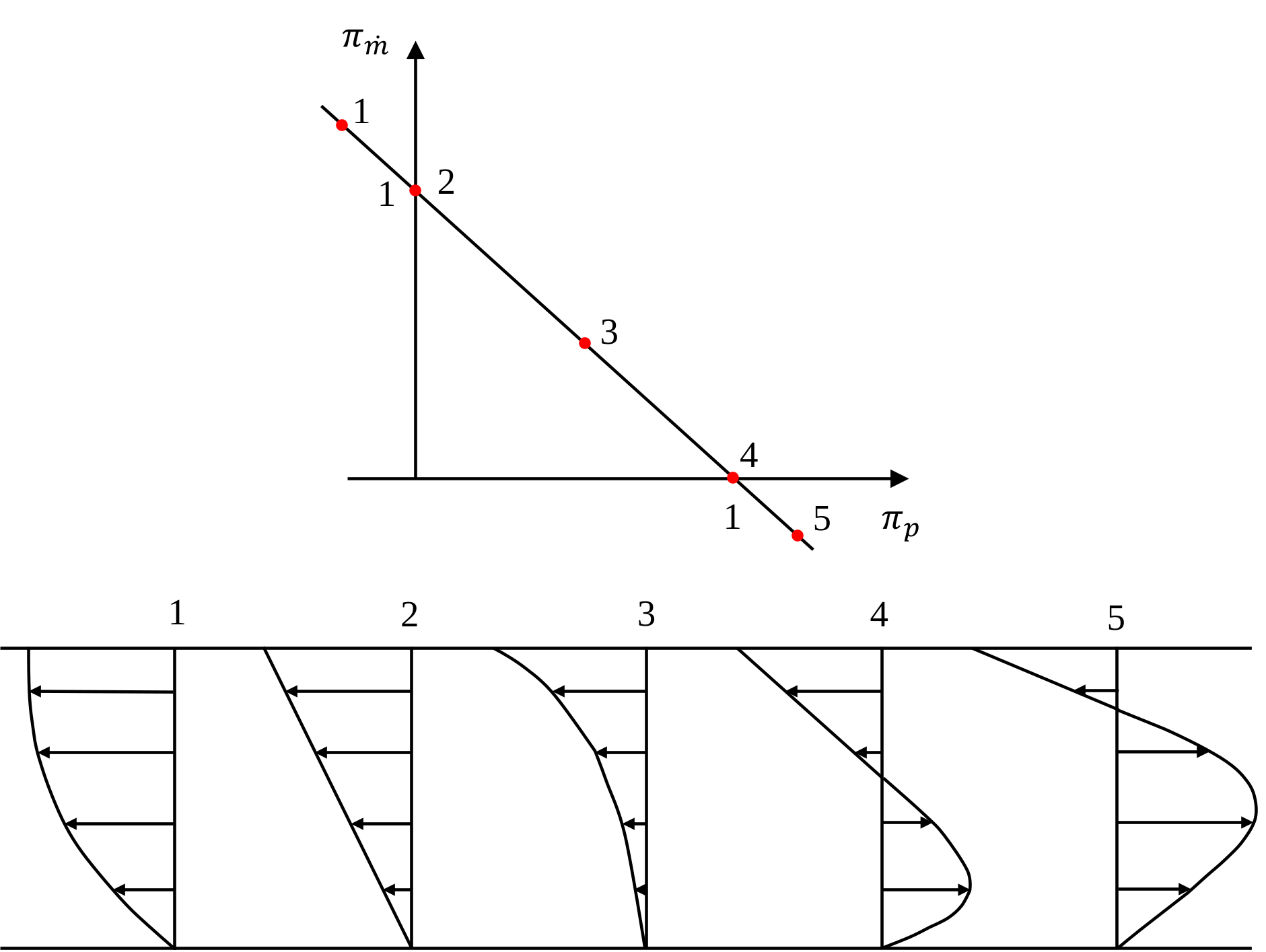
The two dimensionless key figures mentioned above can be used to deduce the flow field in the screw. $π_{\dot m} = 1$ describes a flow that consists purely of a drag flow. There is no pressure gradient here which opposes this flow. $π_{\dot m} = 0$ on the other hand means that no material is conveyed. Here, the effective pressure is so high that the drag flow cannot move against it. If $π_{\dot m} > 1$, the pressure flow supports the drag flow. This is the case with negative pressure gradients, as is often the case in grooved barrel extruders, for example. $π_{\dot m}$ usually moves between 0 and 1. The closer $π_{\dot m}$ is to 0, the better the mixing effect due to the pressure profile overlapping each other, but t worse the conveying effect.
The following graph shows various characteristic flow profiles for different drag and pressure flows for the Newtonian case.
With structurally viscous materials, the curve deviates further and further with decreasing power law coefficients (see following diagram); this is taken into account in the calculation. The figure only shows the one-dimensional case. Taking into account the influence of the web, the cross-flow and the channel curvature, a $\pi_\dot m < 1$ also results for a pure drag flow ($\pi_p = 0$).