Inhaltsverzeichnis
Wave-Zone
In a wave zone, there are wave crests with low channel depth and wave troughs with high channel depth in the channel. In addition to mixing the material, the aim of wave zones is also to break up the solid bed and thus achieve dispersed melting.
Input of a Wave-Zone
General input
The wave zone has a complex channel geometry, which is why the definition of a wave zone also requires many inputs. Inputs similar to a metering zone are required as the basic geometry.
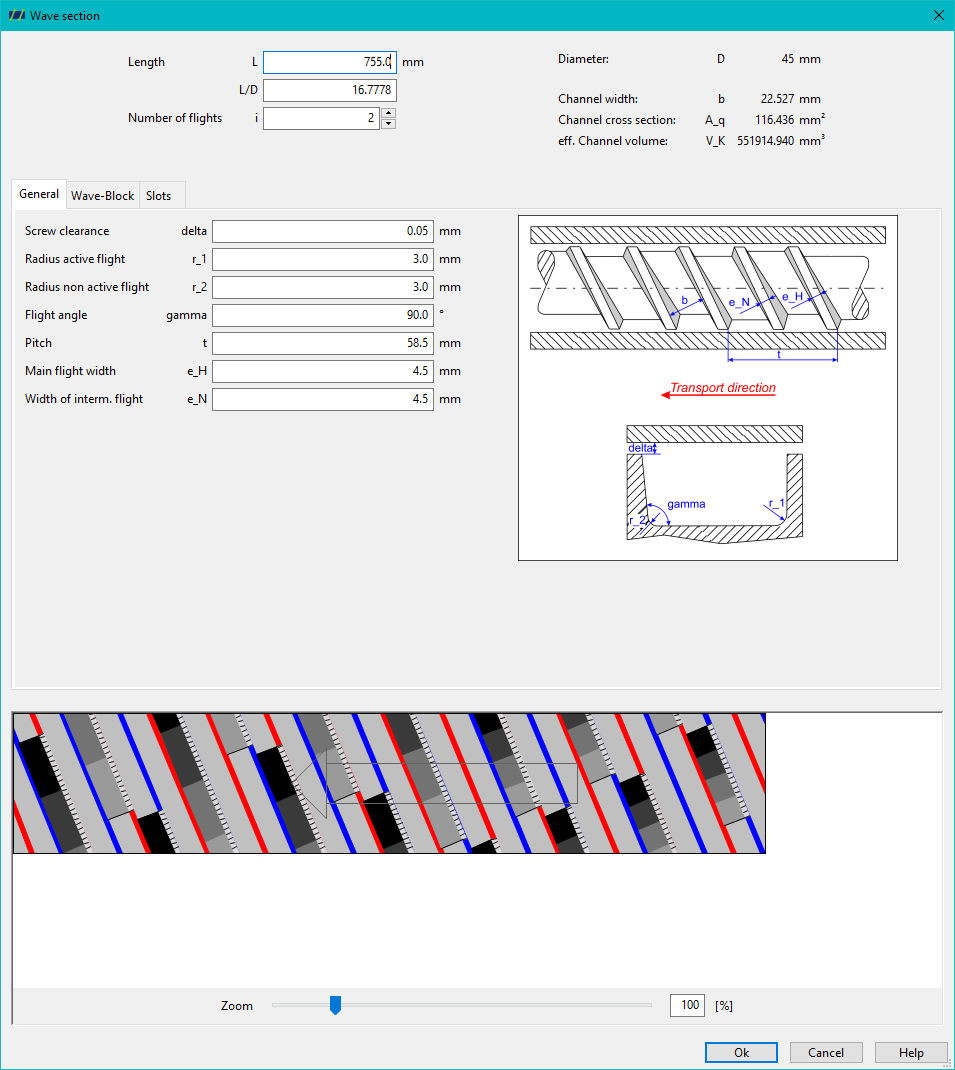
REX/PSI allows the definition of 1 to 4 channels. However, wave screws are typically a two-channel screw concept. With single-flight wave screws, there is a risk of clogging in the channel and are therefore not recommended.
Input of the wave blocks
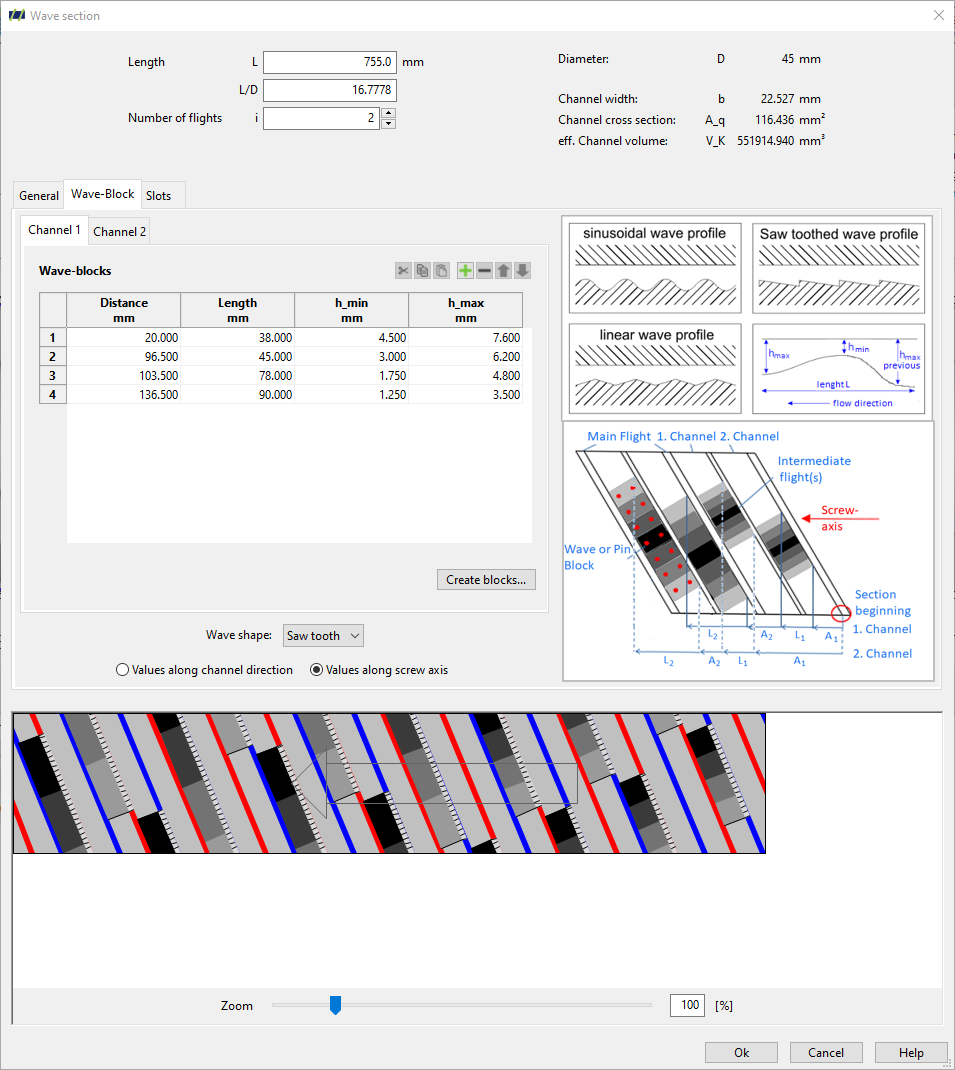
Once the basic geometry data has been entered, the next step is to define the wave blocks. Each channel of the zone must be defined separately. The number of waves per channel is arbitrary, but the total length of the zone must not be exceeded. However, it should be noted that the waveform (sine, linear, sawtooth) must be specified and that the dimensioning can be done either in the channel direction or parallel to the axis. Each wave is defined by the distance to the previous wave (or to the start of the zone), by the length of the wave, the channel depth $h_{min}$ at the so-called wave crest and the channel depth $h_{max}$ behind the wave. The channel depth of the previous zone is present before the first wave.
Entering the web slots
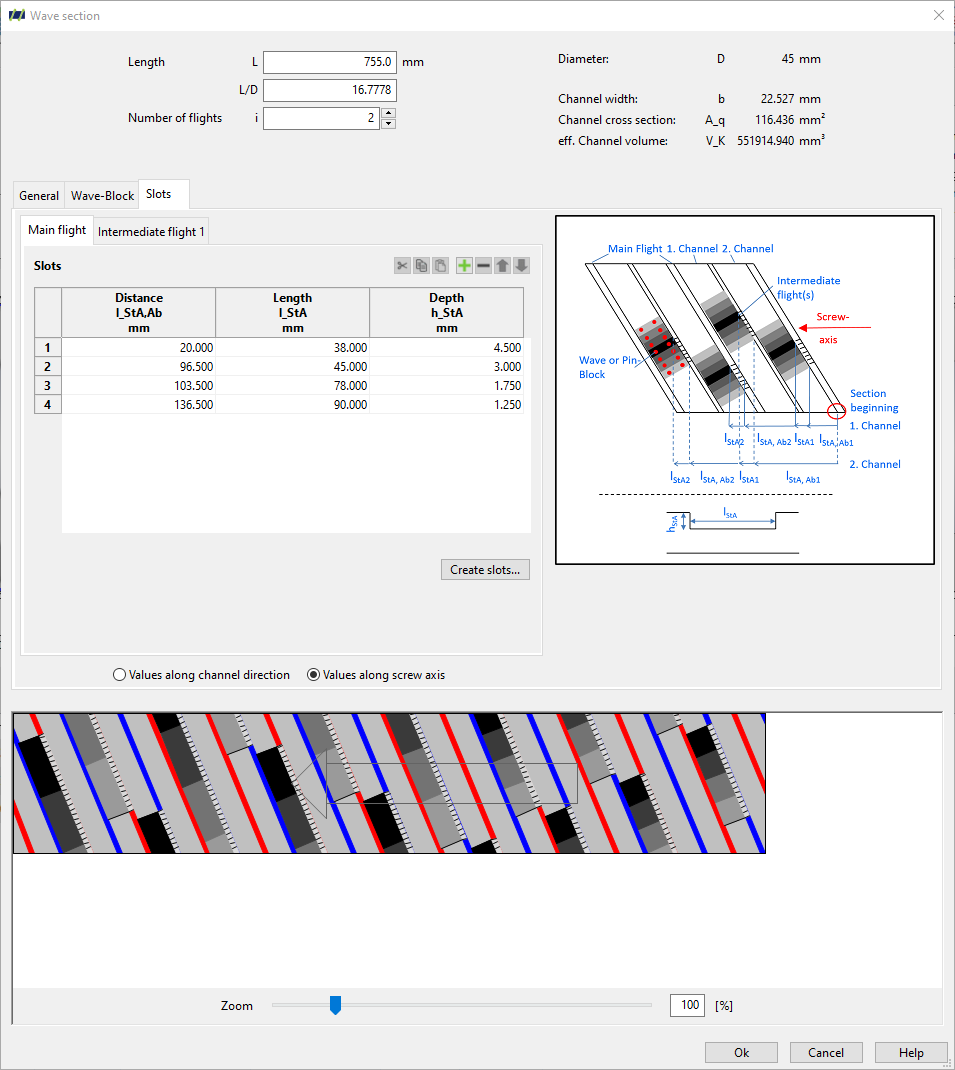
In addition to the wave blocks, slots can be defined for each flight. Here too, the dimensioning can be in the direction of the channel or parallel to the axis. Without flight slots, the two channels are separate.
There are typically 2 wave concepts, which are briefly introduced.
Double-Wave-Screw
A double-wave screw is a two-flight wave screw concept. The implementation in REX is relatively simple here, as the secondary flight is „stepped“ over the entire length of the zone, similar to a barrier screw, i.e. the plastic can flow over the secondary flight continuously. The main flight is not set down so that the conveying behaviour is only slightly affected.
Energy-Transfer-Screw
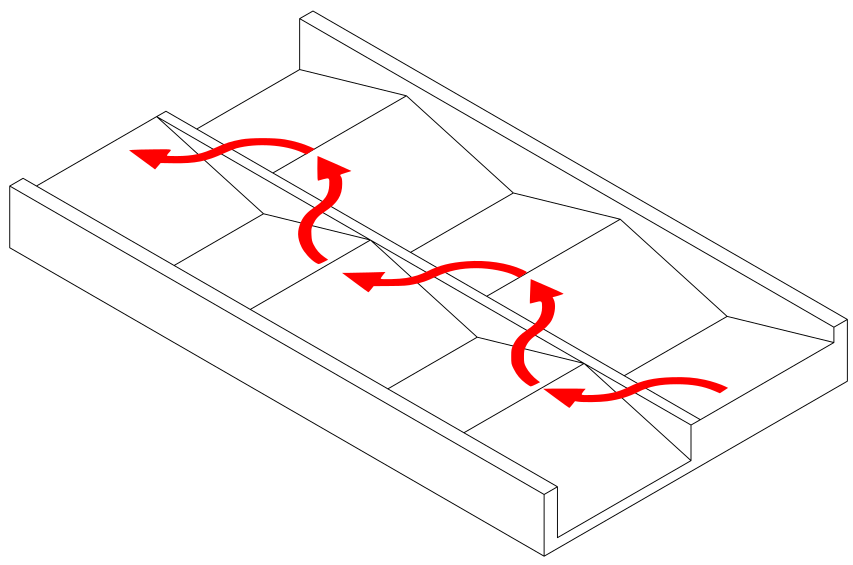
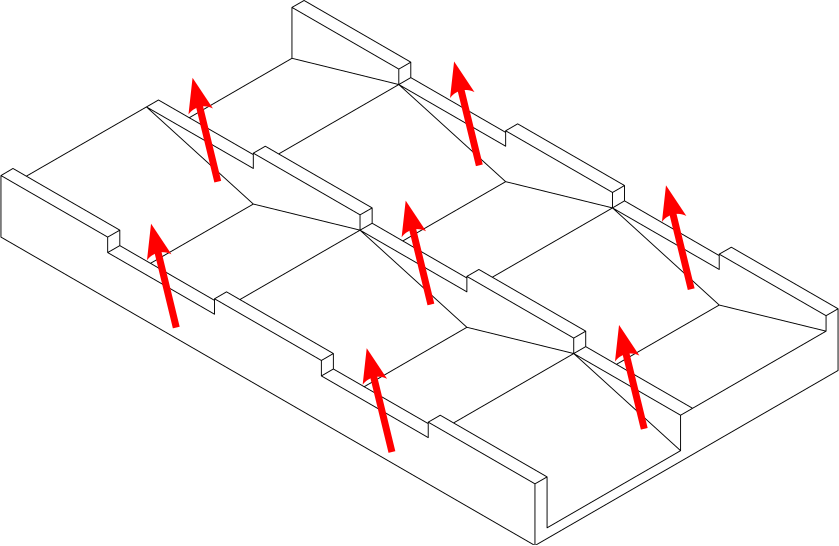
The energy transfer screw is also a two-flight screw concept. In comparison to the double-wave screw, however, there is no division into main and secondary flights, but the flights are always „set down“ on the hopper side parallel to the channel height reduction towards a wave crest. This means that if there is a channel height reduction in a channel, the plastic always flows back into the neighbouring channel in the direction of the extruder hopper against the conveying direction. This reduces the specific throughput but achieves a high mixing effect.
The screw speed can also be increased due to the lower conveying capacity compared to the double-wave screw. This allows a high melting capacity and a high mixing effect at the same time, especially with high throughputs.
Sources
- Pape, Jens: Grundlagen der Prozesssimulation von Einschneckenkonzepten zur Hochleistungsplastifizierung, Dissertation, Universität Paderborn, 2006
- Dörner, Marius: Wave-Schnecken in der Einschneckenextrusion, Dissertation, Universität Paderborn, 2022
- Schall, Christoph: Materialschonende Verarbeitung von Thermoplasten auf Wave-Schnecken, Dissertation, Universität Paderborn, 2023