Dies ist eine alte Version des Dokuments!
Regular calculation
Starting a calculation
There are two ways to start the calculation
- With selection of the calculation and process settings
- Quick calculation with the last used calculation and process settings
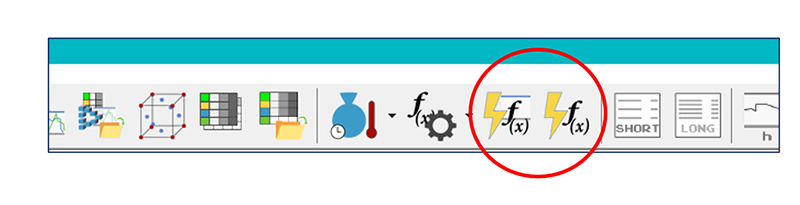
The first selection opens a window in which the process parameters and the calculation settings can be changed. The settings are presented below. Confirming the Calculate… button starts the calculation and the calculation progress and report display appears.
With the 2nd selection, the last known process and calculation settings are used and the progress and report display appears immediately.
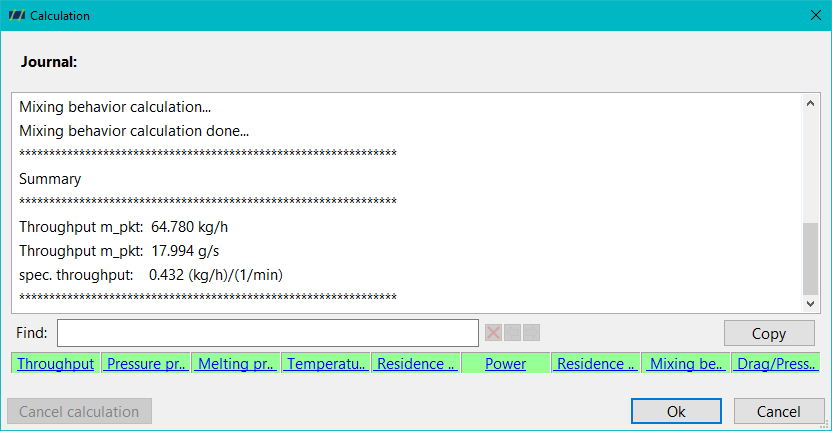
The calculation log appears in the upper part of the progress and report display. The calculation process can be recognised by the sequence at the bottom of the window.
Here means:
- Green: Successful calculation
- Orange: Warning message
- Red: Error message
By clicking on an orange or red field, the log jumps directly to the corresponding warning or error message.
Process parameters
A distinction is made between required and optional process parameters.
The necessary parameters are required for a calculation.
Optional parameters are voluntary inputs that can lead to improved simulation accuracy if the process variables are known.
Necessary process parameters
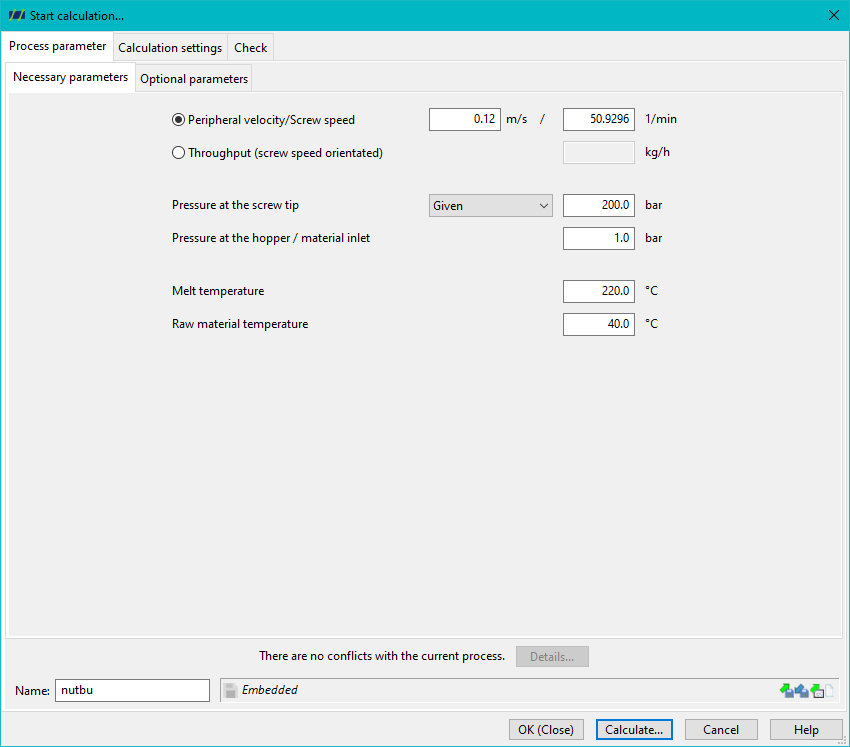
The necessary process parameters require the following inputs:
- Optional specification of a circumferential speed/screw speed OR specification of a throughput (speed-orientated).
If the mass throughput is specified, the speed is calculated iteratively so that the specified throughput is achieved.
The specification of a throughput together with a speed is possible via the optional specification of the mass throughput. - Pressure at the screw tip (specified or mould characteristic curve if a mould is defined)
- Pressure at the front edge of the hopper
- Specification of the final melt temperature (for an initial temperature profile, see also ‘Iterate temperature’ in the calculation settings)
- Raw material inlet temperature
Optional process parameters
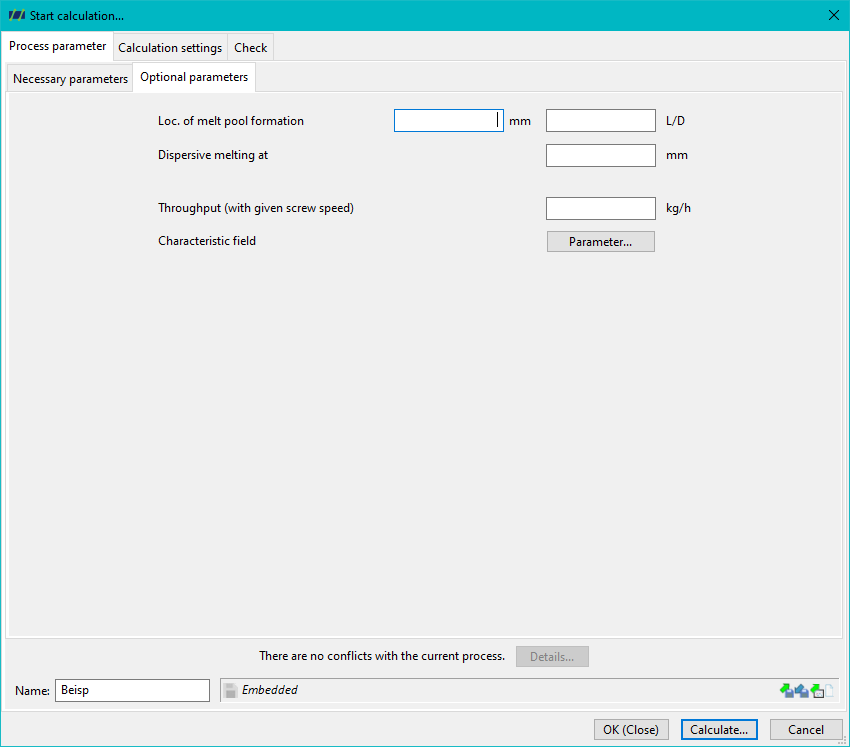
Values can be entered for the optional process parameters with the aim of achieving a more precise calculation accuracy. The following can be specified:
- Location of the melt vortex formation (OSW). Melting begins at this point
- Start of disperse melting. From this point at the latest** the calculation continues with the disperse melting model
- Throughput (at a specified speed)
- Parameters for the characteristic curve field. 3 speeds and 3 back pressures can be specified here so that characteristic curves for the extruder can be calculated automatically in a full factorial test plan (9 test points) (not yet implemented in REXng)
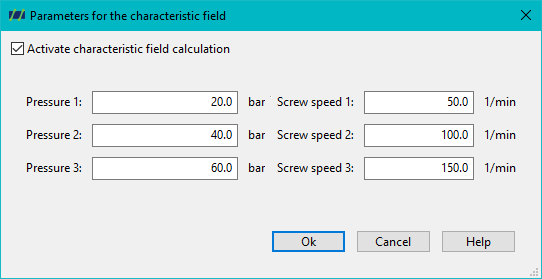
Calculation settings
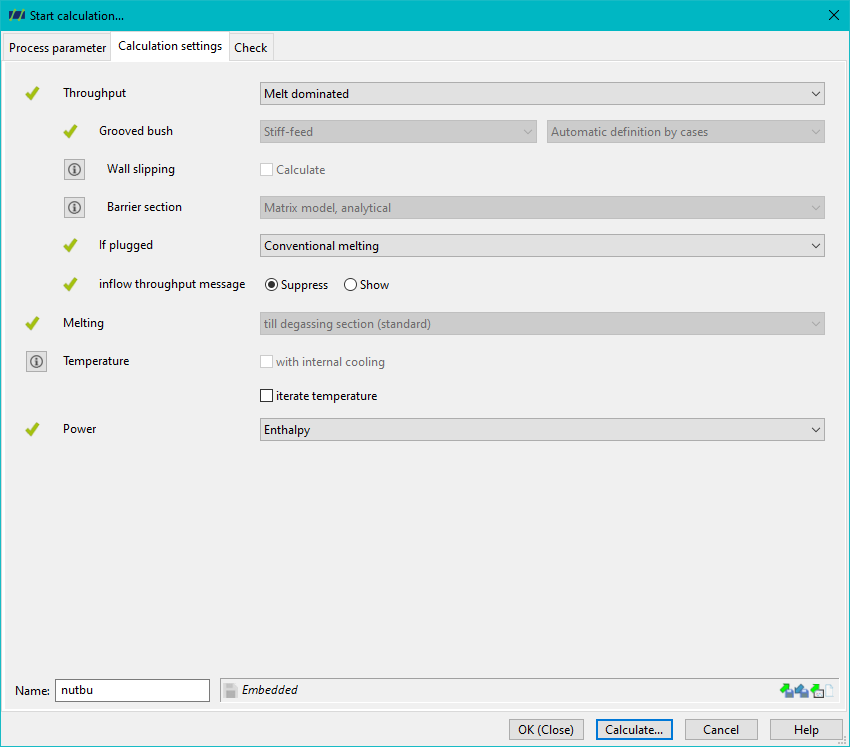
The calculation settings are divided into 4 sections:
Throughput
- see also throughput
Three basic settings are possible here
- Melt dominated: Standard setting, melt conveying dominates the throughput
- Coupling solids conveying: the Solids conveying of the feed zone is also taken into account
- Slot bushing: the throughput is determined by the
Grooved bush (Grooved bush calculation).
If a grooved bush is defined, you can also select whether the calculation
- Conveyor stiffness (default) or
- limit speed orientated
and the conveying case differentiation can also be selected.
You can also select whether the throughput calculation should take Wall-slipping into account. In this case, corresponding material data are required.
For screws with barrier zones, there are two options for calculating the pressure throughput
- The analytical nodal point method: based on network theory, standard
- Assumption of a constant pressure gradient between the solids and melt channel
If a barrier zone becomes blocked (solids bed width y in the solids channel achieved by compressing the channel over 100% channel width, within a barrier zone), the following options are available
- Continued conventional melting, in this case the solid changes into the melt channel and conventional melting is calculated in both channels
- Disperse melting from the location of the blockage
If solid bed widths of more than 100% outside a barrier zone occur, the melting calculation is cancelled with a warning message.
It is also possible to select whether the message of an insufficient feed throughput through the hopper should be displayed or suppressed. It only makes sense to display the message if a hopper has been defined. Otherwise, a round hopper opening the size of the extruder's nominal diameter is assumed.
Melting
- see also Melting
For degassing screws only, three options can be selected:
- to degassing zone: Standard, the melting calculation stops at the first degassing zone
- from degassing zone conventional: conventional melting also in/after the degassing zone. However, if disperse melting has already been forced, for example by a shearing part before the degassing zone, disperse melting will continue to be calculated.
- from degassing zone disperse: disperse melting in/after the degassing zone
Temperature
* see also Temperature
* If Iterate temperature is not selected, the calculation is only calculated with an initial temperature profile. This is described by a linear progression of the temperature from the melting temperature ($T_G$ / $T_K$) at the front edge of the hopper to the specified final melt temperature (see necessary process parameters) at the screw tip. For degassing extruders, the specified final melt temperature already applies to the start of the first degassing zone and remains constant thereafter.
If Iteration of the final temperature is selected, the calculated temperature profile is used iteratively for a new calculation of the entire process until a stationary state (no change in the final temperature) is reached.
- If an internal temperature control is defined, the calculation of the internal temperature control can be activated or deactivated.
Power
Check
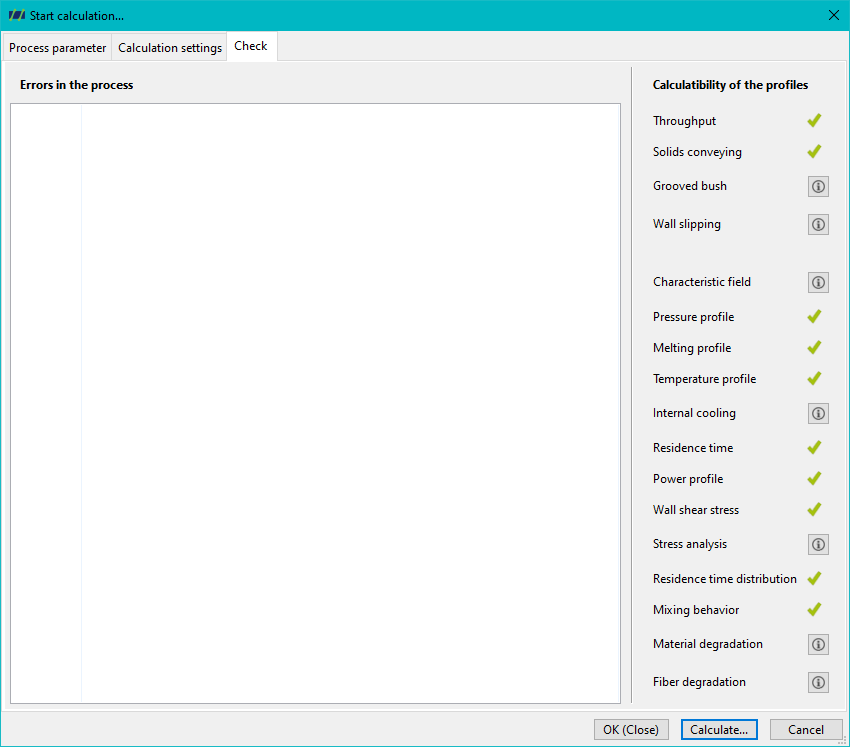
The Check overview summarises which curves and parameters can be calculated (green tick) or cannot be calculated (exclamation mark).
Click on the exclamation mark to display the reason why a curve or parameter cannot be calculated.