Degassing index calculation
→ For graphical representation of the degassing key figures
Degassing can only take place at the melt surface, with each screw rotation a defined area is present in the degassing zone. The renewal time oft he pushing flight indicates how long it takes for the melt to move out and back into the degassing zone:
$$t_{deg} = \frac{h}{D \cdot π \cdot N \cdot sinφ}$$
The degassing surface $A_{deg}$ is the surface of the melt which is in contact with the air and can degas, divided by the renewal time this gives the surface renewal rate:
$$A_{deg} = i \cdot h \cdot \frac{L}{\sin\varphi}$$
Furthermore, from the specific surface renewal and the mass throughput, a characteristic degassing index can be derived:
$$\pi_{deg} = \frac{A_{deg}}{ \sqrt{t_{deg}} \cdot \dot m}$$
The degassing surface depends solely on the length of the partially filled section. The renewal time decreases with increasing screw speed. The residence time is accounted for via the throughput in the characteristic degassing index.
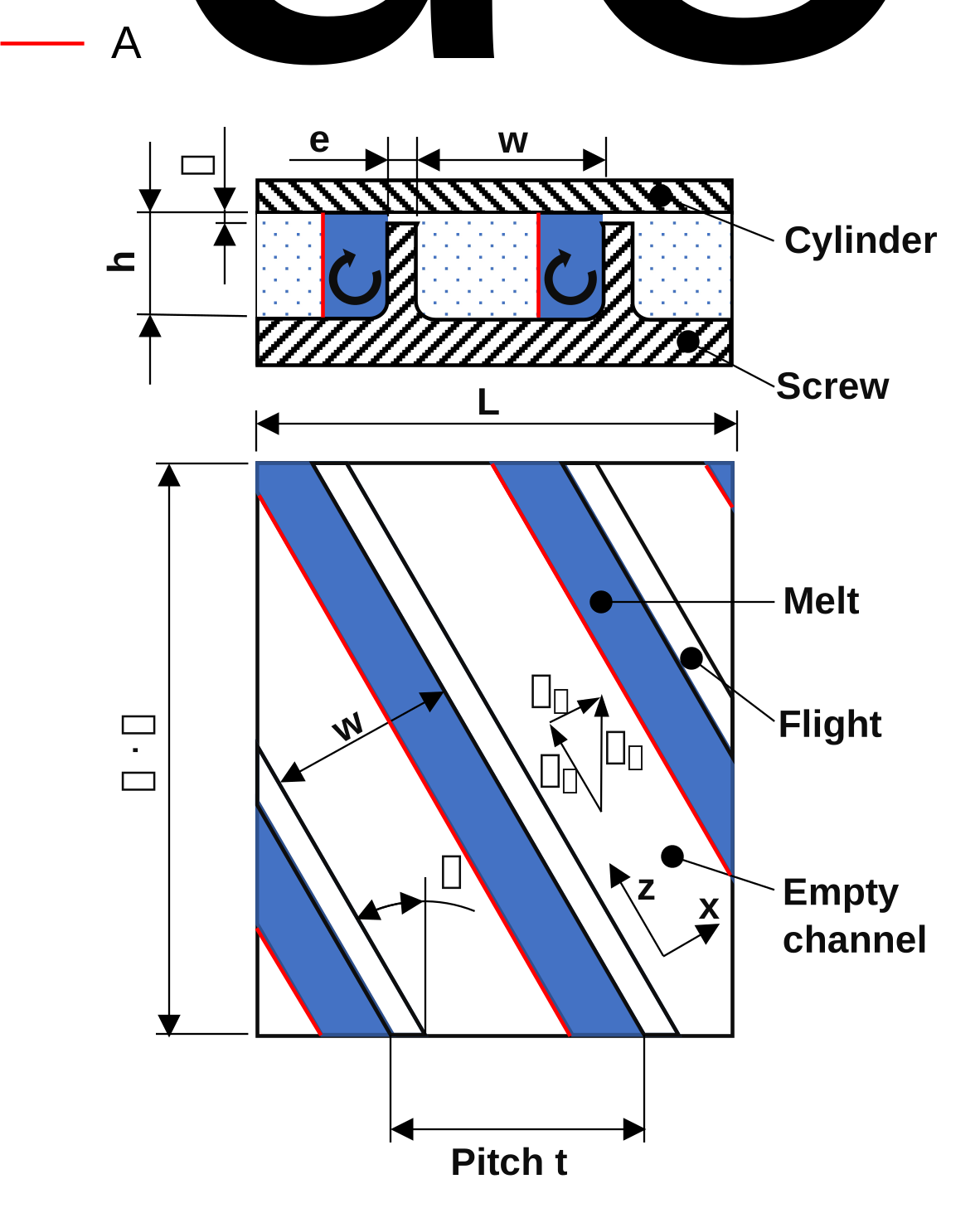
The filling level f is calculated for all unpressurised intervals and results in:
$$f = \frac{\dot{V}_{extruder}}{\dot{V}_{local}}$$
A pure drag flow is assumed locally. The filling level corresponds to the melt fraction (blue) in the given figure.
Source
- Schuler, W.: Degassing during polymer production and processing.
Tagungsband: Various Aspects of Ethylene-Propylene Based Polymers, Academia-Erasme, Louvain-La-Neuve, 1991