Dies ist eine alte Version des Dokuments!
Solids conveying
Consideration of solids transport
In REX, solids conveying refers to the consideration of the pressure-throughput behaviour of pellet conveying in the feed area of a smooth tube extruder.
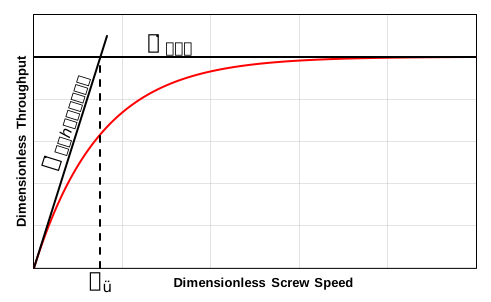
When modelling the pressure set, not only the maximum (back pressure-dependent) throughput within the screw ($\dot m_{Schneider}$), but also the limited trickling behaviour ($\dot m_{max}$) is taken into account. The combination of these two models results in the back pressure-dependent throughput of the entire feed zone (red curve) considered in REX.
Theoretical basics
The equation for calculating the solids flow rate is as follows:
$\frac{\dot m}{\dot m_{max}} = 1- e ^ {-\frac{N}{N_ü}*x}$
The value $x$ represents a factor that is used to fit the calculated data to the simulation data.
$\dot m_{max}$ describes the maximum possible single trickle throughput and results as a regression from simulation data:
$\dot m_{max} = 3,615 * \rho_s * g^{0,5} * L_T * D^{1,5}*\frac{h}{D}*\left( \frac{t}{D} \right) ^{-0,27}*\left( \frac{D}{D_{max}} \right) ^{0,75}$
with the bulk density $\rho_s$ measured according to the standard, the gravitational acceleration $g$, the length of the hopper opening $L_T$, the channel depth $h$, the channel gradient $t$, the diameter $D$ and the maximum diameter $D_{max} = 250 mm$.
Based on the throughput calculation according to Schneider, which is not reproduced in detail here, the transition speed $N_ü$ is now calculated as follows:
$N_ü = \frac{\dot m_{max}}{\rho_s*B*h*\pi*D}*\frac{sin(\alpha+\varphi)}{sin(\alpha)}$
with the bulk density $\rho_s$, the channel width $B$, the channel depth $h$, the diameter $D$, the back pressure-dependent solids conveying angle according to Schneider $\alpha$ and the pitch angle $\varphi$.
Sources
- Trippe, Jan Klaus: Erweiterung der Modellierung zur Durchsatz- und Leistungsberechnung von Feststoffförderprozessen in der Einschneckenextrusion, Dissertation, Universität Paderborn, 2018
- Schneider, K.: Der Fördervorgang in der Einzugszone eines Extruders, Dissertation, RWTH Aachen, 1968
Application in REX
A solids conveying throughput can be calculated from the theoretical principles with a known back pressure of the feed zone.
If the calculation setting for the throughput ‘Coupling solids conveying’ is selected, the calculation in REX/PSI is performed as follows:
Firstly, the melt-dominated throughput without solids conveying is calculated. From this, the pressure at the melt vortex formation is calculated back from the screw tip and the known back pressure. The melt vortex formation is assumed to be the location up to which there is pure solids conveying and therefore serves as the interface between melt conveying and solids conveying.\
Based on the known location and pressure at the melt vortex formation, the solids conveying throughput can then be calculated. This can be higher or lower than the melt-dominated calculated throughput.
If the calculated throughput is lower, the pressure at the melt vortex formation is recalculated with a reduced throughput from the tip of the leg. The back pressure of the solids conveying zone is therefore lower and the solids conveying throughput is therefore higher.
The flow rate is now iterated until the pressure at the melt vortex formation is reached, for which the melt-dominated flow rate and the solids conveying flow rate are identical.
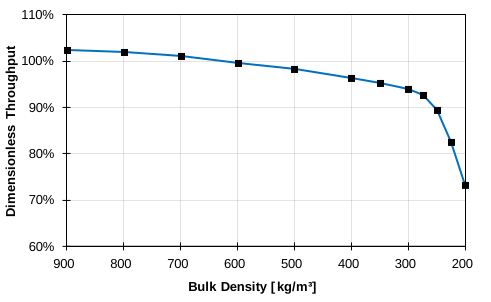
The influence of the bulk density can be seen for an exemplary process in the following figure. The throughput is standardised to the purely melt-dominated throughput. A value of 100 % therefore corresponds to the melt-dominated throughput.
Message throughput
In addition, REX/PSI offers the option of displaying a warning message about the throughput of the trickle. The warning message is not displayed by default, but can be activated in the calculation settings.
The warning message appears if the entry flow rate $m_{max}$ is less than 1.25 times the calculated flow rate. This is to warn of possible underfeeding.