Dies ist eine alte Version des Dokuments!
Drag pressure flow
The dimensionless throughput $π_{\dot m}$ describes the mass flow related to the mass flow caused by the drag flow. The mass flow of the pure drag flow can be described as follows:
$\dot m = 0,5 \cdot ρ \cdot h \cdot B \cdot v_0$
If the total mass flow is now related to the drag flow, this results:
$π_{\dot m} = \frac{\dot m}{(0,5 \cdot ρ(T) \cdot h \cdot b \cdot v_{0z}}$
The dimensionless pressure gradient describes the influence of the pressure gradients on the total flow. It is defined by the following equation:
$π_p = \frac{(h^{1+n} \cdot Δp)}{(6 \cdot v_{0z}^n \cdot Z \cdot n^{0,94} \cdot K(T))}$
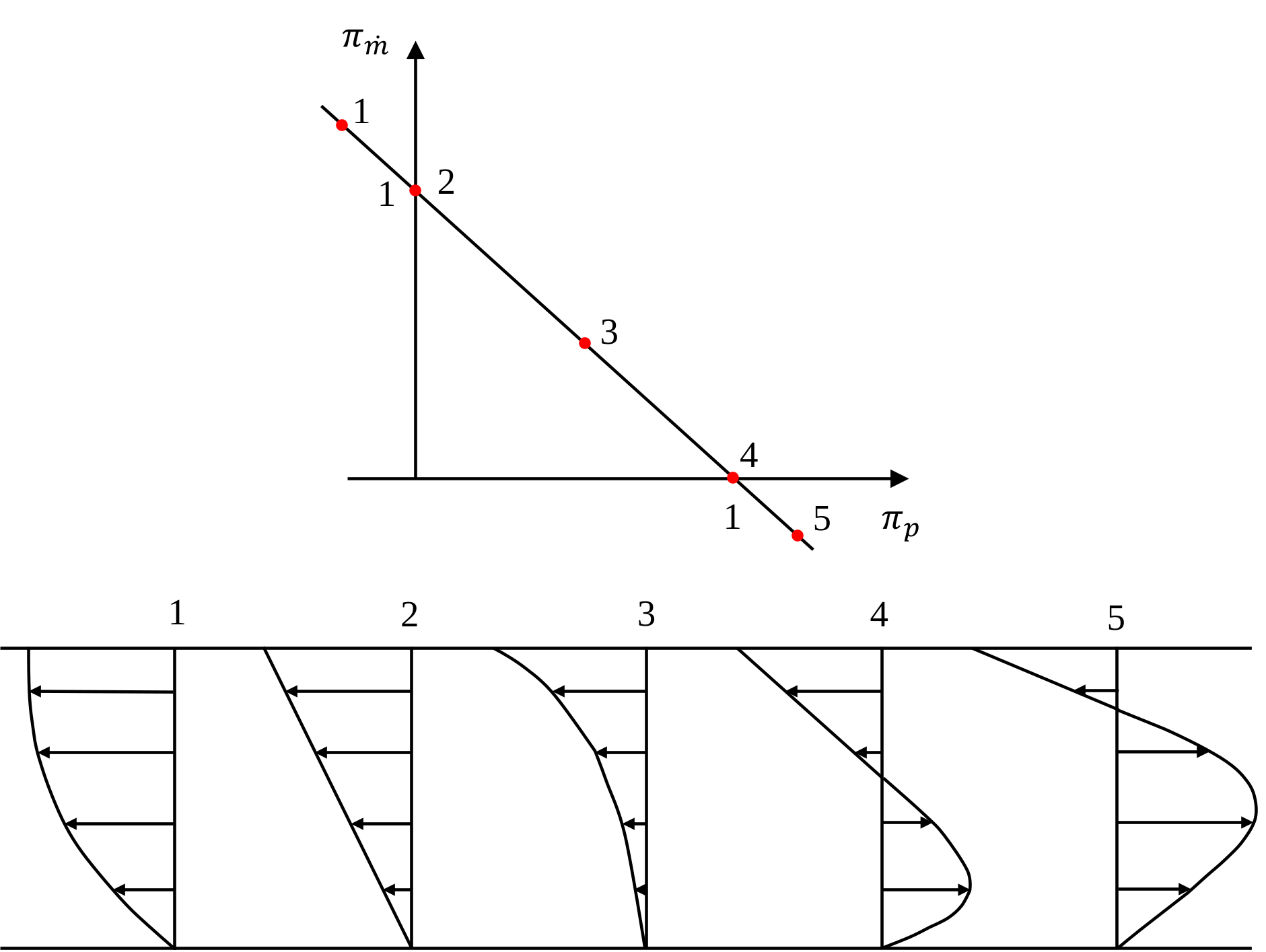
The two dimensionless key figures mentioned above can be used to deduce the flow field in the screw. $π_{\dot m} = 1$ describes a flow that consists purely of a drag flow. There is no pressure gradient here which opposes this flow. $π_{\dot m} = 0$ on the other hand means that no material is conveyed. Here, the effective pressure is so high that the drag flow cannot move against it. If $π_{\dot m} > 1$, the pressure flow supports the drag flow. This is the case with negative pressure gradients, as is often the case in grooved barrel extruders, for example. $π_{\dot m}$ usually moves between 0 and 1. The closer $π_{\dot m}$ is to 0, the better the mixing effect due to the pressure profile overlapping each other, but t worse the conveying effect.
The following graph shows various characteristic flow profiles for different drag and pressure flows for the Newtonian case.
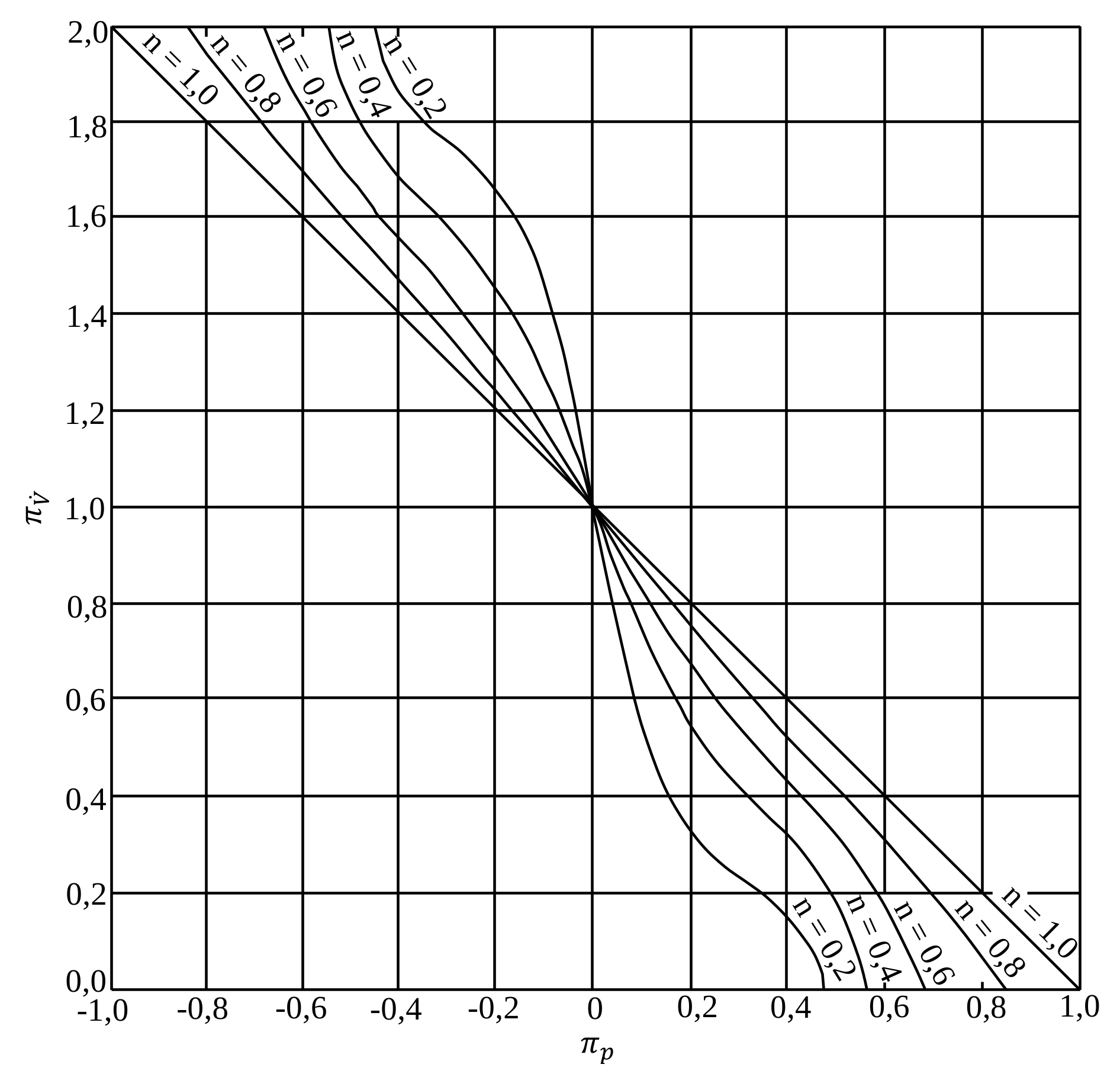
With structure-viscous materials, the curve deviates further and further with decreasing power-law coefficients (see following graphic). This is taken into account in the calculation.
Symbols:
$π_{\dot m}$ : Dimensionless mass flow
$π_p$ : Dimensionless pressure gradient
$ρ(T)$ : Melt density at the respective temperature T
$h$ : Channel depth
$b$ : Channel width
$v_{0z}$ : Peripheral speed in channel direction
$\dot m$ : Throughput
$Δp$ : Pressure gradient
$Z$ : Unwound channel length
$n$ : Power law exponent
$K(T)$ : Consistency factor at respective temperature T