Dies ist eine alte Version des Dokuments!
Temperature profile
Theoretical Fundamentals of Temperature Calculation
REX calculates the temperature in the melt pool and the melt film for each interval downstream of the location of melt pool formation (OSW). Due to the progressive melting process, the continuously growing melt film becomes thicker and is simultaneously scraped off by the screw flights. As a result, not only does the melt pool become warmer due to barrel heating and shear dissipation, but the mixing with the usually cooler melt film is also taken into account. Therefore, the temperature increase per unit length of the screw during melting can be lower than after the melting process is complete. The consideration of the melt film is based on the first law of thermodynamics.
At the location where the melt pool forms, the initial temperature of the melt pool is calculated. This initial temperature lies between the melting temperature of the polymer and the barrel temperature. Based on this initial temperature, the subsequent temperature development is calculated. Optionally, the starting temperature of the melt pool can also be specified as an optional process parameter.
Temperature Calculation in PSI
Additionally, for each interval in PSI, a proportionate residence time is taken into account. The approach is very similar to the consideration of residence times during melting.
For the residence-time-weighted calculated residence time per interval, heating or cooling purely due to heat conduction from the barrel temperature control is calculated. The more residence time the polymer experiences from entering the injection molding machine until injection, the closer the temperature profile approaches the heating zone temperature profile.
Special features in the temperature calculation
There are two special cases that affect the temperature calculation. These are disperse melting and the internal tempering of a screw.
Influence of disperse melting on the temperature
If dispersed melting occurs (e.g. due to user specifications or a shearing or mixing element), this is also reflected in the temperature curve. During dispersed melting, the unmelted plastic is distributed in the plastic melt and is heated by heat conduction from the surrounding melt and also melted.
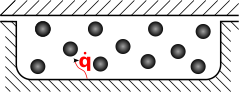
The heat flow causes the melt to cool down:
$\Delta T = \frac{\dot q_{particle} * N * t}{c_p * V_{melt} * \rho}$
with the heat flow per particle $\dot q_{particle}$, the number of particles $N$, the residence time $t$, the heat capacity of the melt $c_p$ and the mass of the surrounding melt $V_{melt} * \rho$
At the same time, the solid particles in the channel result in a reduced effective channel height, which leads to a locally increased shear rate in the melt:
$\dot \gamma = \frac{v_{0,z}}{h}$ for a solids content of 0 %
$\dot \gamma = \frac{v_{0,z}}{h-d_{particle}*N_{height}}$ for a solids content > 0 %
with $v_{0,z}$ as the circumferential velocity, the channel height $h$, the particle diameter $d_{particle}$ and the number of particles at channel height $N_{height}$
The temperature reduction and the simultaneously higher shear rate counteract each other, so that different behaviour can occur depending on the process. As a rule, however, the cooling of the melt predominates, so that disperse melting leads to a cooler melt temperature. The temperature reduction is taken into account via the first law of thermodynamics and therefore evenly across the melt channel with the boundary condition that the temperature profile at the cylinder always corresponds to the cylinder temperature. The increased shear rate is taken into account directly in the calculation of the temperature profile over the channel height.
Sources
- Pape, Jens: Grundlagen der Prozesssimulation von Einschneckenkonzepten zur Hochleistungsplastifizierung, Dissertation, Universität Paderborn, 2006
- Dörner, Marius: Wave-Schnecken in der Einschneckenextrusion, Dissertation, Universität Paderborn, 2022
Influence of the internal temperature control on the temperature
The internal temperature control is calculated iteratively.
First, the temperature curve without internal temperature control is always calculated. The steady-state heat flows for the constant screw base temperature profile can be calculated from the known volume flow of the temperature control medium, the geometry and thermal conductivity of the screw and the inner tube as well as the known screw base temperature.
The temperature calculation is then carried out again, taking into account the heat flow into the tempered screw core. The resulting temperature reduction only occurs at the base of the screw and leads to an inhomogeneous temperature profile over the channel height. As a result, a cooler screw base temperature is calculated, which in turn is used to calculate the heat flows in the tempering medium and within the screw.
With the heat flow into the screw core now reduced, the temperature calculation is started again. The process is carried out iteratively until a stationary process is reached.
