Dies ist eine alte Version des Dokuments!
Wall-slipping materials
The content is currently being processed and will be made available shortly. Please be patient.
When considering the flow processes in rheometers but also in practical modules such as dies, plasticating units and between gaps, the flowing melt is presumed to be wall adhering. In polymer melting this is true for the majority of the materials. However, there are some materials, among which the ultrahigh molecular polyethylene of high density (HDPE) and the economically important polyvinylchloride (PVC, frequently provided with outward lubricants for a gentle processing), which are wall slipping under certain conditions.
In order to calculate the plastisicating process with the simulation programs REX and PSI, the option “wall slipping” has been added in the software. For this, critical shear stress values must be entered in the rheological material data as explained in the Chapter Rheological Material Data.
When choosing the menu item Wall slipping, REX/PSI considers that wall slipping occurs above the critical wall shear stress. For this, the shear stresses at the barrel wall and the root surface are evaluated and limited to a value whose maximum is equal to the critical shear stress at the wall.
$$τ_ {WH,S} > τ_{krit} ⇒ τ_S = τ_{krit}$$
This limitation has an effect on the flow profile in the screw channel and reduces the local pressure gradient. This reduces the pressure build-up capacity, but also the pressure consumption of screw zones that are passed over.
If a wall-sliding material is to be calculated with REX/PSI, two pairs of values consisting of a test temperature and the critical wall shear stress determined at this test temperature must be entered in addition to the characterisation of the flow law using the Carreau or Arrhenius parameters.
In addition, the material parameter $k_{mat}$ can be used to describe the increase in the dimensionless sliding velocity $V_{sl}^*$ as a function of the dimensionless shear stress $τ^*$. The required material data, such as the sliding velocity $v_{sl}$ as a function of the wall shear stress $τ$, is determined during the viscosity measurement (e.g. with a high-pressure capillary rheometer).
During the measurement of the pressure as a function of the volume flow, discontinuities occur in the double logarithmic diagram for wall-sliding melts in contrast to wall-adhering melts.
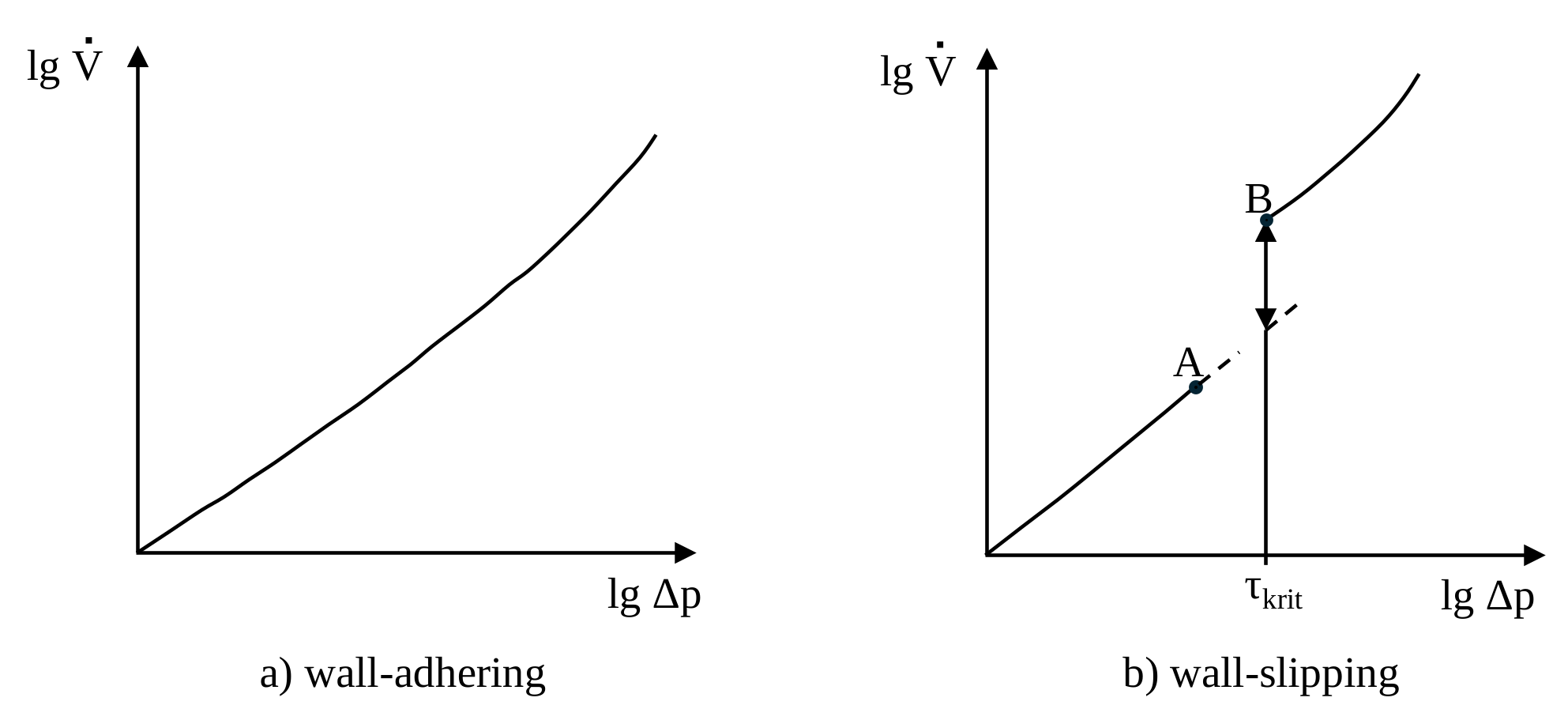
From the critical pressure $Δp_{krit}$ at which this discontinuity occurs, the critical wall shear stress $τ_{krit}$ can be calculated for a rectangular capillary using the following formula:
\[τ_{krit} = \frac{\Delta p_{krit}}{2} \frac{h}{l}\]
These critical shear stresses can be approximated as a straight line equation depending on the temperature. Therefore, REX/PSI requires the input of two pairs of values for the critical shear stress and the corresponding temperature.