Dies ist eine alte Version des Dokuments!
Representation of Mixing effectiveness
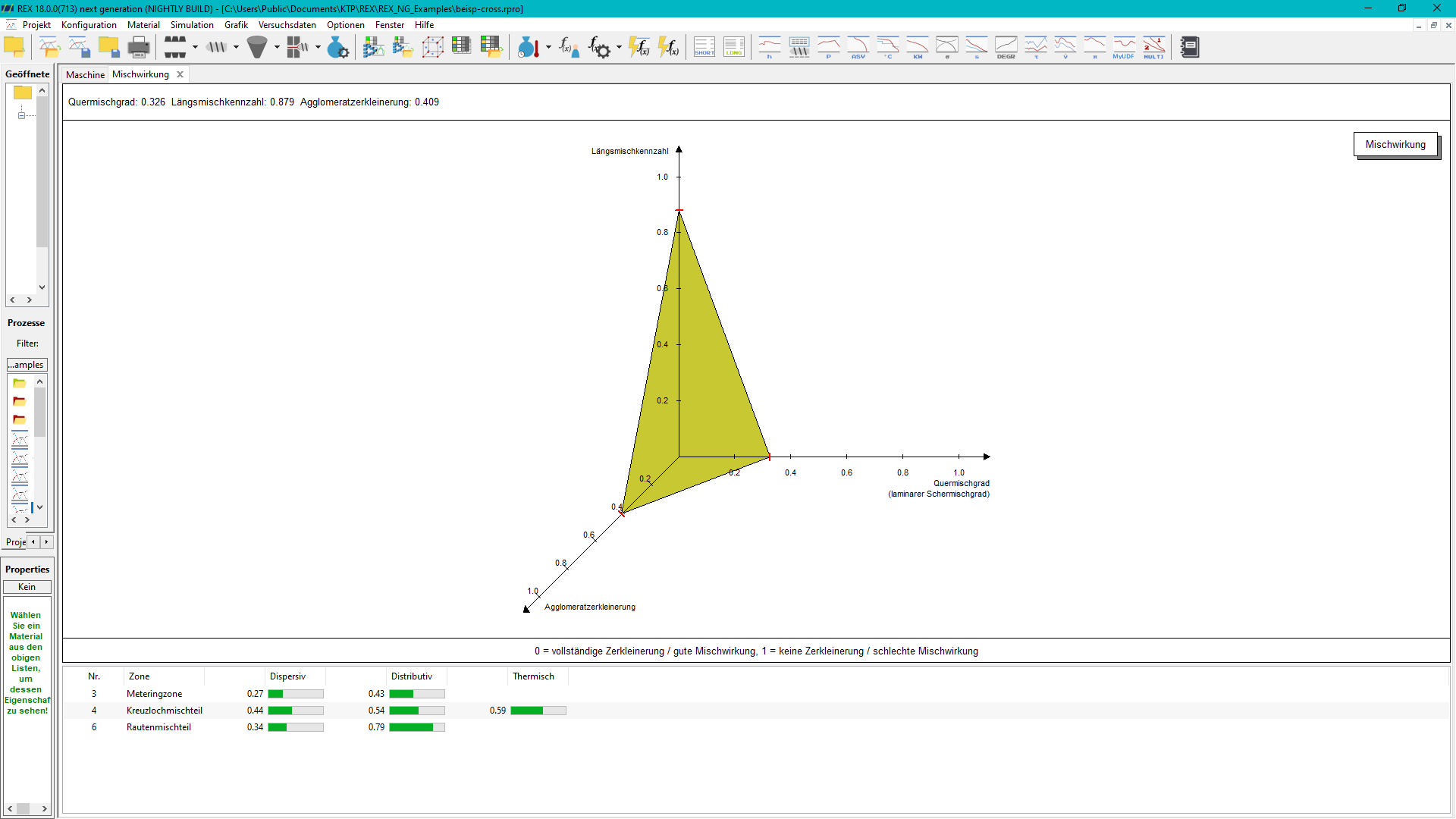
The results of the mixing effect of different shearing and mixing parts can be viewed via the special diagram Mixing effect.
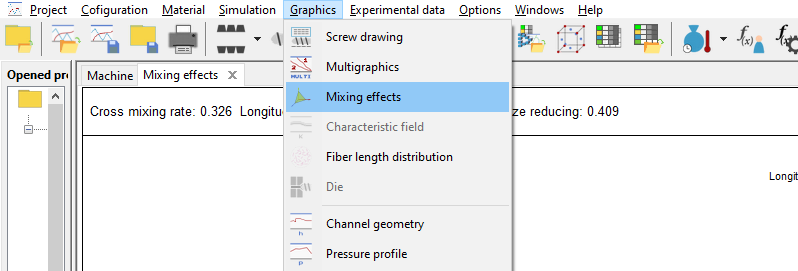
By clicking on the menu item Mixing effect in the item Graphic, the following visualization appears.
Numerical mixing effectiveness
The numerical mixing quality is calculated from the following two parameters to
determine the dispersive and distributive mixing quality, which are weighted from
100% - good to 0% - poor:
Currently, the numerical mixing quality calculation is available for faceted mixing
section, metering section and spiral shearing section. The calculation is made only
for sections in which there is a completely melted melt, since the basis of the ratio are
CFD simulations.
1. Dispersive mixing effectiveness
The dispersive mixing quality is based on a regression equation for the so-called mixing index according to Manas, which was determined by means of numerical investigations using a CCD test plan. The mixing index according to Manas is a quantitative measure for describing the mixing quality of numerical investigations, which allows conclusions to be drawn about the dispersive mixing behaviour. The index is determined from the deformation gradient and the vortex tensor: \[ \lambda = \frac{|\Gamma|}{|\Gamma| + |\omega|} \] \[ \nabla \vec{v} = \begin{pmatrix} \frac{\partial v_x}{\partial x} & \frac{\partial v_x}{\partial y} & \frac{\partial v_x}{\partial z} \\ \frac{\partial v_y}{\partial x} & \frac{\partial v_y}{\partial y} & \frac{\partial v_y}{\partial z} \\ \frac{\partial v_z}{\partial x} & \frac{\partial v_z}{\partial y} & \frac{\partial v_z}{\partial z} \end{pmatrix} \]
\[ \Gamma = \frac{\left(\nabla \vec{v} + \nabla \vec{v}^T\right)}{2} \]
\[ \omega = \frac{\left(\nabla \vec{v} - \nabla \vec{v}^T\right)}{2} \]
\(\lambda\): Manas-number
\(\Gamma\): Deformation tensor
\(\omega\): Vortex tensor
\(\nabla \vec{v}\): Velocity gradient
The Manas number characterises the type of flow present and is subdivided as
follows:
- λ = 1 pure strain
- λ = 0,5 pure shear flow
- λ = 0 pure rotation
2. Distributive mixing effectiveness
The distributive mixing quality is based on a regression equation determined by means of a CCD experimental design for the evaluation method of a particle distribution based on the Delaunay triangulation, which was carried out as follows: Based on the numerically calculated flow area, the particle trajectory of a particle distribution determined at the beginning of the flow area or at the beginning of the geometry can be calculated by means of the so-called particle tracking method. The particle distribution localised at the end of the flow area in the two-dimensional crosssection was then examined for homogeneity. For this purpose, a triangular mesh was created with the help of Delaunay triangulation. As a parameter for the evaluation or as a measure of the mixing quality, the correlation that homogeneous surface areas of the spanning triangles go hand in hand with a homogeneously distributed particle distribution is used here. The so-called coefficient of variation, which relates the standard deviation of the triangular areas to the mean area, is used as the evaluation parameter. If all particles are evenly distributed, the coefficient of variation is zero (mixing quality 100 %); the coefficient of variation of the initial distribution (all particles in one half of the channel) is defined as 0 %.
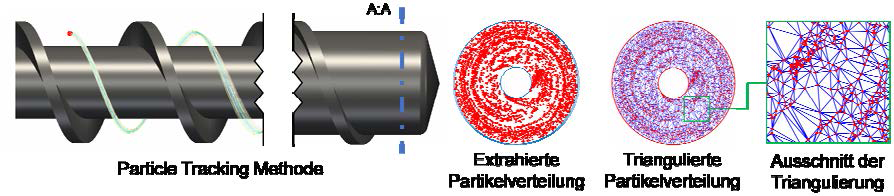
3. Thermal mixing effectiveness
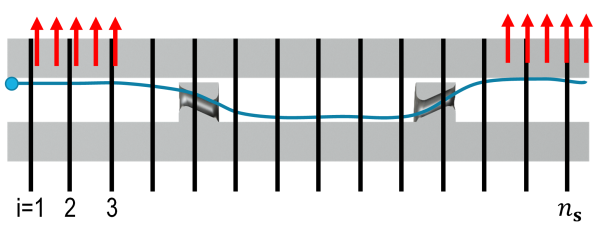
An additional parameter is calculated for the cross-hole mixing section, which evaluates the effectiveness of the radial temperature equalisation. This is necessary because a targeted temperature exchange radial to the channel does not correlate with the results of the distributive mixing effect. For mixing sections that aim for general mixing (circumferential, radial and longitudinal direction), the thermal mixing effect correlates with the distributive mixing effect. For the cross-hole mixing section, which forces an exchange between fluid layers at the base of the screw and the cylinder wall, a separate consideration is required. By definition, no direct statement about temperature distributions can be obtained from the isothermal CFD simulations. For this reason, the trajectory of each individual particle is analysed as part of particle tracking. The position in the channel is evaluated over the course of the mixing section and the Graetz number is analysed in order to map the influence of the operating point. A high mixing effect is achieved when all particles have spent sufficient time at the cylinder wall and screw base and effectively switch between the two areas.