Dies ist eine alte Version des Dokuments!
Drag-pressure flow
The content is currently being processed and will be made available shortly. Please be patient.
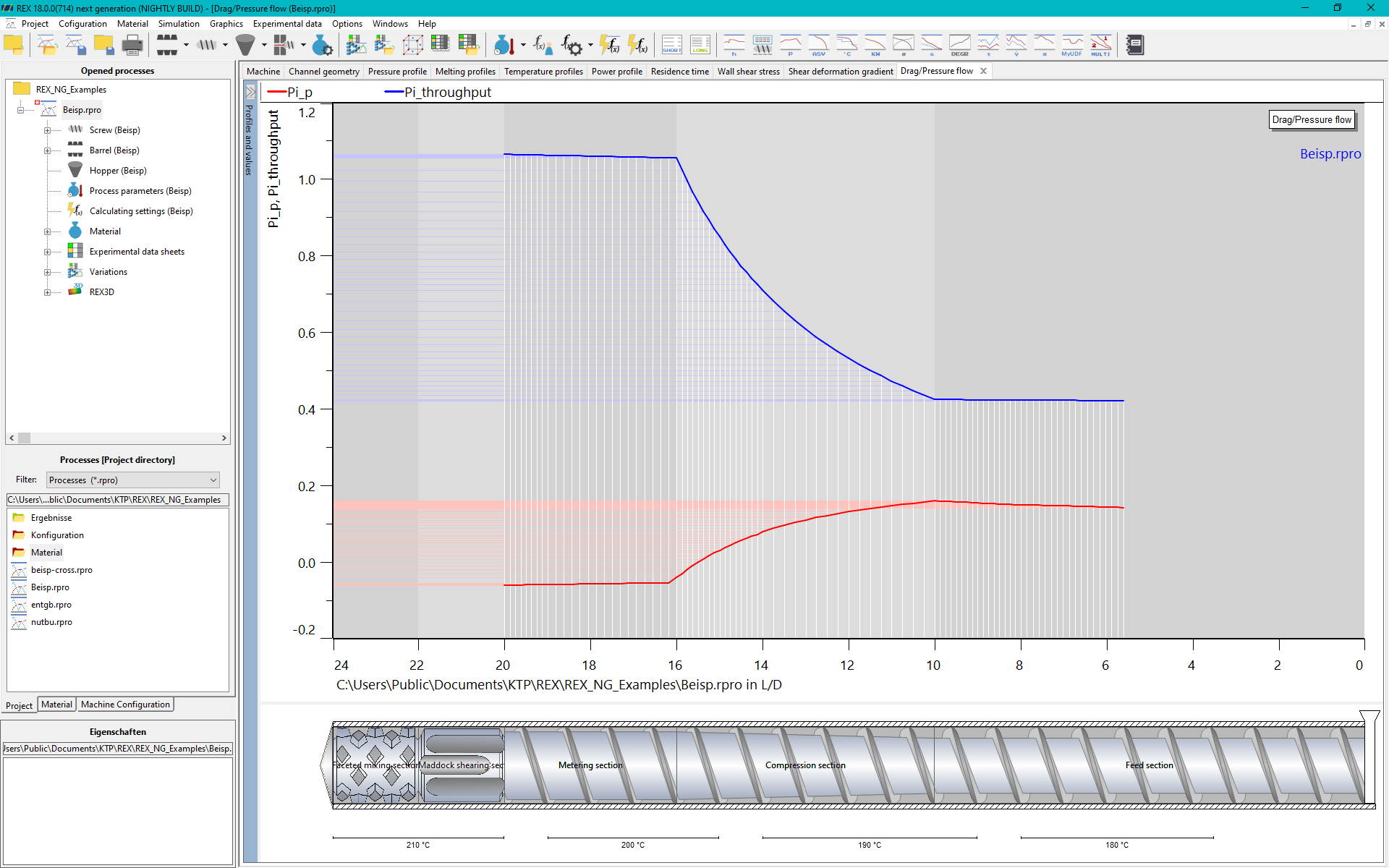
The drag pressure flow is an important mechanism in the plasticising process of a screw extruder. It describes the interaction between the drag flow caused by the screw rotation and the pressure flow generated by the pressure difference along the screw. Both types of flow affect the material flow and influence the throughput and quality of the extruded material. In the technical analysis, the dimensionless throughput (πm˙πm˙) and the dimensionless pressure gradient (πpπp) are graphically represented as key parameters.
Aufrufen des Diagramms
Description of the parameters
- Dimensionless throughput ($\pi_{\dot{m}}$): The dimensionless throughput describes the conveying capacity of the extruder as a function of the flow conditions and the screw geometry. This value is represented by the ratio of the actual mass flow rate to a standardised reference value. A high dimensionless throughput indicates efficient material conveying, while a low value may indicate potential blockages, high friction or insufficient conveying. In the diagram, the course of the dimensionless throughput is shown as a curve that runs along the length of the screw. This curve provides information on how the throughput varies in the different zones of the screw - from the feed zone to the plasticising zone to the discharge zone.
- Dimensionless pressure gradient ($\pi_p$): The dimensionless pressure gradient describes the change in pressure along the screw. This gradient is a measure of how much the pressure increases or decreases in the various sections of the extruder. It is crucial for understanding the pressure flow, which is driven by the pressure difference along the screw. A positive pressure gradient means that the pressure along the screw is increasing, while a negative pressure gradient indicates a pressure release. These pressure changes significantly influence the shear stress of the material and therefore also the homogeneity and quality of the melt. The course of the pressure gradient is also shown as a separate curve over the length of the screw and provides an insight into the pressure distribution along the screw.
Interpretation of the diagram
- Interaction of drag and pressure flow: In an ideal extrusion process, drag flow (due to screw rotation) and pressure flow (due to pressure gradient) work together in equilibrium. The drag flow conveys the material along the screw, while the pressure gradient provides additional forces to support or regulate the material flow.
- Progression of the dimensionless flow rate: Typically, the dimensionless throughput shows a slow increase in the feed zone as the material is initially compacted here. In the plasticising zone, where the material begins to melt, the throughput can increase sharply as the material becomes more flowable. In the discharge zone, the flow rate should remain constant to ensure that the molten material is conveyed evenly.
- Progression of the dimensionless pressure gradient: The pressure gradient varies depending on the screw geometry and material properties. The pressure gradient can increase in areas with high compression or narrower screw flights. In degassing zones or at the end of the screw, the pressure often drops to allow the material to be relieved before it exits.