Dies ist eine alte Version des Dokuments!
Wall shear stress
The graphical representation of the wall shear stress curve provides a comprehensive analysis of the mechanical stress on the material in the screw extruder, particularly with regard to the shear forces acting on the material at the walls of the extruder channel. These stresses are caused by the relative movement between the screw wall and the molten material. A detailed investigation of the wall shear stress curve is essential in order to understand the melting process and optimise material processing.
Visualisation of the wall shear stress curves
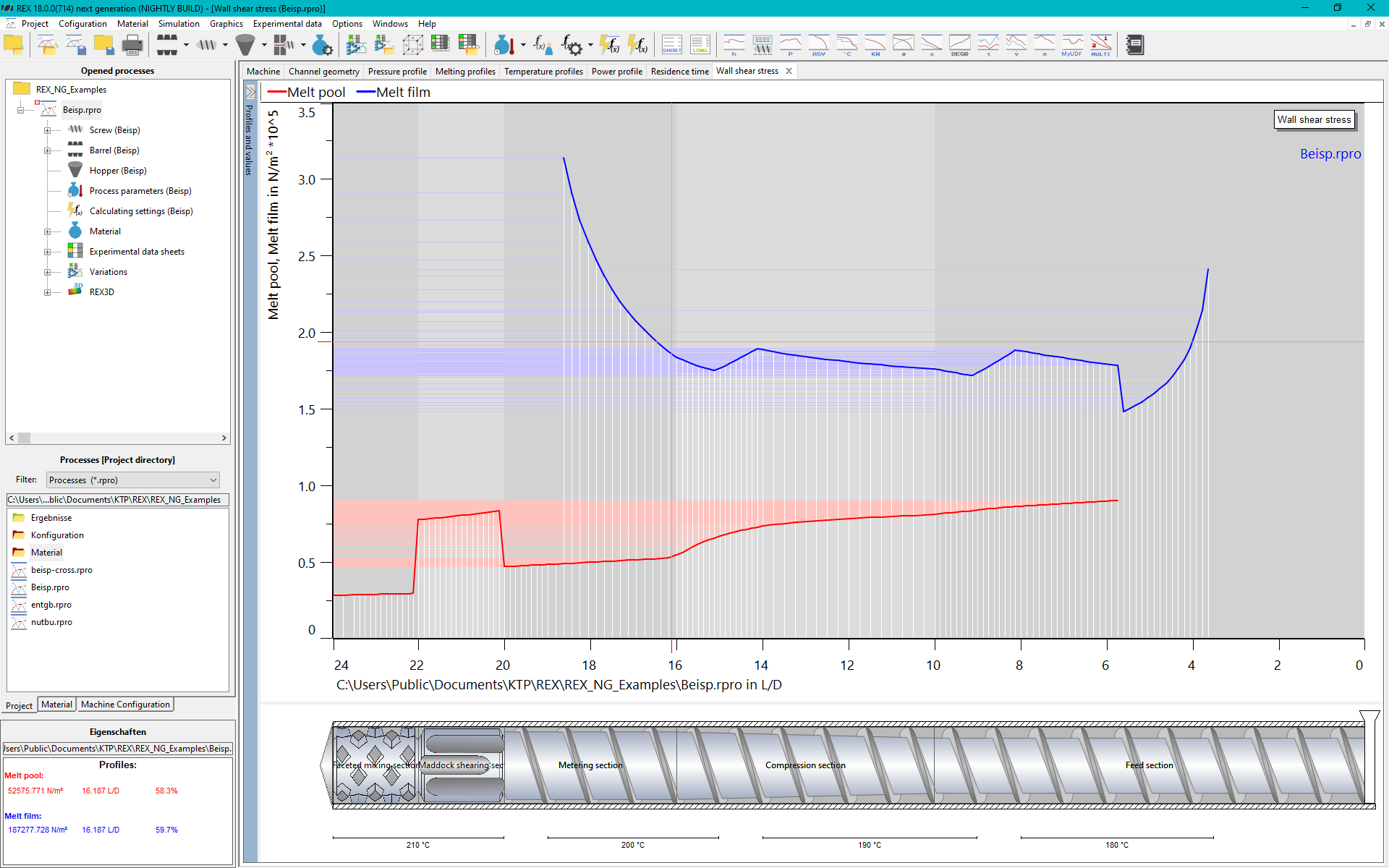
The wall shear stress is shown over the entire length of the screw. In the lower part of the graphic, the screw is displayed in the calculation position so that the exact position in the screw can be identified. Above this, the curves of the wall shear stress for two different zones of the melting process are plotted in a diagram:
Wall shear stress for the melt vortex
- The red curve represents the wall shear stress curve for the melt vortex. This curve starts at the first heating zone of the screw extruder, where material heating and mechanical stress from the rotating screw begin, and ends at the melting end.
- The melt vortex describes the area in which the material begins to give up its solid form and changes to a partially melted state. This is where the first significant shear stresses act on the material, which are decisive for the transition from solid granulate to melt.
- The course of the red curve provides information on how strong the shear stress is in the area of the melt vortex and how it develops along the length of the screw until complete melting.
Important features and influences on the wall shear stress curve
- Screw length and geometry: The wall shear stress depends heavily on the geometry of the screw. Areas with a greater flight pitch or narrower flight width generate higher shear stresses, as the material is more compressed and mechanically stressed. Such changes in geometry can often be recognised by sudden increases in the curves.
- Temperature and viscosity: The thermal heating of the material in the heating zones directly influences the viscosity of the melt and thus also the wall shear stress. A more viscous material generates higher shear stresses as it requires more energy to be conveyed through the screw flights.
- Melt vortex and melt film: The transition from the melt vortex to the melt film marks a significant point in the melting process. While the melt vortex area is characterised by high shear stresses in order to melt the material, the melt film area enters a phase in which the wall shear stresses are stabilised and the melt is conveyed more evenly.