Dies ist eine alte Version des Dokuments!
Rheological material data
Input dialogue
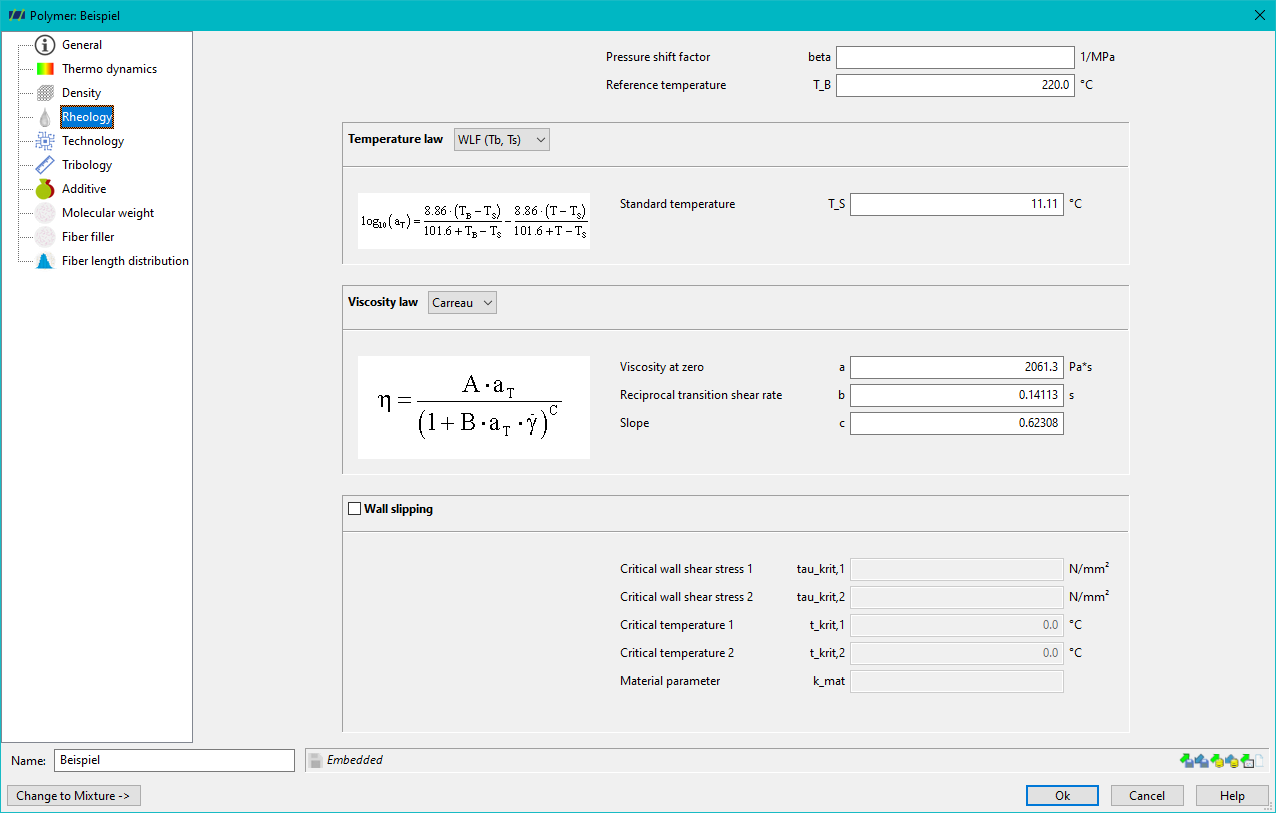
The rheological data of the material is entered in the ‘Rheology’ tab:
- Pressure shift factor beta, this input is optional. Without an input value, the pressure dependence of the viscosity is neglected.
- Reference temperature T_B, the values entered in the viscosity approach are valid for this temperature.
- Temperature approach, the temperature dependence of the viscosity can be modelled here. The temperature shift is calculated using PAM. The following modelling options are available
- WLF (Tb, Ts): Temperature shift by specifying the standard temperature T_S
- WLF (C1, C2): Temperature shift due to the constants C1 and C2
- Arrhenius: Temperature shift due to activation energy E
- Viscosity approach, the equation for describing the viscosity can be selected here. The following models are available:
- Carreau: Input of the 3 parameters a, b and c
- Potency: Input of the parameters K and n
- Wall sliding: If the checkbox is selected, the critical shear stress at 2 temperatures must be entered. See calculation of wall sliding
Flow behaviour of plastics
Fluids can be divided into two groups on the basis of their flow characteristics:
- Newtonian fluids
- Non-Newtonian fluids
For Newtonian fluids the following law applies:
\[τ=η\cdot\dotγ\]
with shear stress $τ$, the viscosity $η$ and the shear rate $\dotγ$.
This law states that the shear stress and the shear rate are proportional to each other, with viscosity being the proportionality factor. In the case of polymeric fluids respectively melts this flow behavior occurs at a very low shear rate and occasionally with very high ones. Deviations are manifested in so-called structural viscosity, dilatancy or the presence of a flow limit.
The flow behavior of polymer melts is characterised in the shear rate ranges that exist in practice by structural viscosity. This describes a flow behavior which deviates from that of Newtonian fluids, where the viscosity is no longer constant but highly dependent on the shear rate.

The following illustration shows the basic profile of the viscosity against the shear rate. Where the shear rate range is not too large it is possible to describe this behavior through the empirically established power flow law according OSTWALD und DE WAELE:
\[τ=K\cdot\dotγ^n\]
$n$ is the exponent of the flow lay and $K$ is the flow lay coefficient.

With the simple setup of this law nearly all flow problems, which are ascertainable for Newtonian fluids, can be treated analytically. In the double logarithmic depiction there is also for the power law model a straight line. As shown in the next figure, each curve segment has to be calculated with the corresponding flow exponent $n$. The consistency factor $K$ is described by:
\[K = K_{0T}\cdot e^{-β(T-T_0)}\]
The constant $K_{0T}$ corresponds to the viscosity at the shear rate and the reference temperature $T_0=0°C$; the temperature dependence of the viscosity is described.

A better description of further areas of the viscosity function is offered by the CARREAU-law, especially with materials which show a pronounced transition from the Newtonian to the low viscosity area:
\[η = \frac {Aa_T} {(1+a_TB\dotγ)^C}\]
Here, $A$ is the zero viscosity, $B$ the reciprocal transition shear rate and $C (= 1-n)$ the pitch.

Temperature shift factor α
The temperature dependence is considered by the temperature shift factor aT which can be determined from the WLF-relation:
Carreau-WLF ($T_B$, $T_S$):
\[lg(a_T) = \frac {C_1\cdot(T_B-T_S)} {C_2+(T_B-T_S)} - \frac {C_1\cdot(T-T_S)} {C_2+(T-T_S)}\]
$T_B$, $T_S$ are given, $C_1 = 8,86$, $C_2 = 101,6$
o r
Carreau-WLF ($C_1$, $C_2$):
\[ln(a_T) = - \frac {C_1 \cdot (T-T_B)} {C_2+(T-T_B)}\]
$C_1$, $C_2$, $T_B$ are given
with: $T_B$ = reference temperature, $T_S$ = standard temperature, $T$ = current temperature
Carreau-Arrhenius ($E$, $T_B$):
\[K = K_{0T}exp[\frac{\Delta E}{R} (\frac{1}{T}-\frac{1}{T_0})]\]
with: $E$ = activating energy, $R$ = gas constant, $K_{0T}$ = physical size at the temperature $T_0$, $T_0$ = reference temperature
With the Carreau-law the polymer specific material behavior can be described over large shear rate and temperature areas.
Pressure shift factor β
The pressure shift factor beta considers the pressure’s influence on the viscosity. The value refers to an average material specific temperature from PAM and to a reference pressure of 100 bar. The pressure dependent viscosity is calculated with the following equation.
\[y(p) = (p_0)\cdot e^{β(p-p_0)}\]

The value beta can be imported directly from PAM or entered manually. If 0 is entered as the value for beta, the viscosity is calculated without considering the pressure.
As the law can only be used analytically to a limited extent, from this function the corresponding coefficients of the power law model are calculated internally for the occurring shear rates and temperatures. You can choose between three different laws in the input mask Rheology. All of them describe the rheological behavior of polymer melts. The difference of the laws is their description of the temperature shift function. This distinction has been introduced to guarantee an easy input despite different sources of the data (CAMPUS, BAYMAT, VISCOSITY). If the Carreau-WLF data is taken for example from the BASF database VISCOSITY, the setting Carreau-WLF ($C_1$, $C_2$) has to be chosen. If you want to calculate with a material from BAYER, the data can be taken from the BAYMAT file and entered with the help of the setting Carreau-WLF ($T_B$, $T_S$). Both constants $C_1$ and $C_2$ are here internally set to 8.86 or rather to 101.6 and cannot be edited.
If you want to calculate a wall-slipping material with REX/PSI, you have to characterize the flow law with the help of the Carreau or the Arrhenius parameter. In addition you have to enter two pairs of variates, consisting of a test temperature and the critical wall shear stress determined at this test temperature.
Additionally, with the material parameter $k_{mat}$ the increase of the dimensionless sliding speed $V_{sl}^*$ in dependence of the dimensionless shear stress $τ^*$ can be described. The determination of the necessary material data, like the sliding speed $v_{sl}$ in dependence of the wall shear stress $τ$, occurs during the viscosity measurement (e.g. with a high pressure capillary rheometer).
At measuring the pressure in dependence of the volume flow, with wall-slipping melts discontinuities occur in the double-logarithmic diagram as opposed to wall-adhering melts.

From the critical pressure $Δp_{krit}$ at which this discontinuity occurs, with the following formula the critical wall shear stress $τ_{krit}$ can be calculated for rectangular capillaries:
\[τ_{krit} = \frac{\Delta p_{krit}}{2} \frac{h}{l}\]
These critical shear stresses can be indicated approximately as straight line equations in dependence of temperature. Thus, you have to enter two pairs of variates in REX/PSI for the critical shear stresses and the temperature belonging to it.