Dies ist eine alte Version des Dokuments!
Thermodynamic data
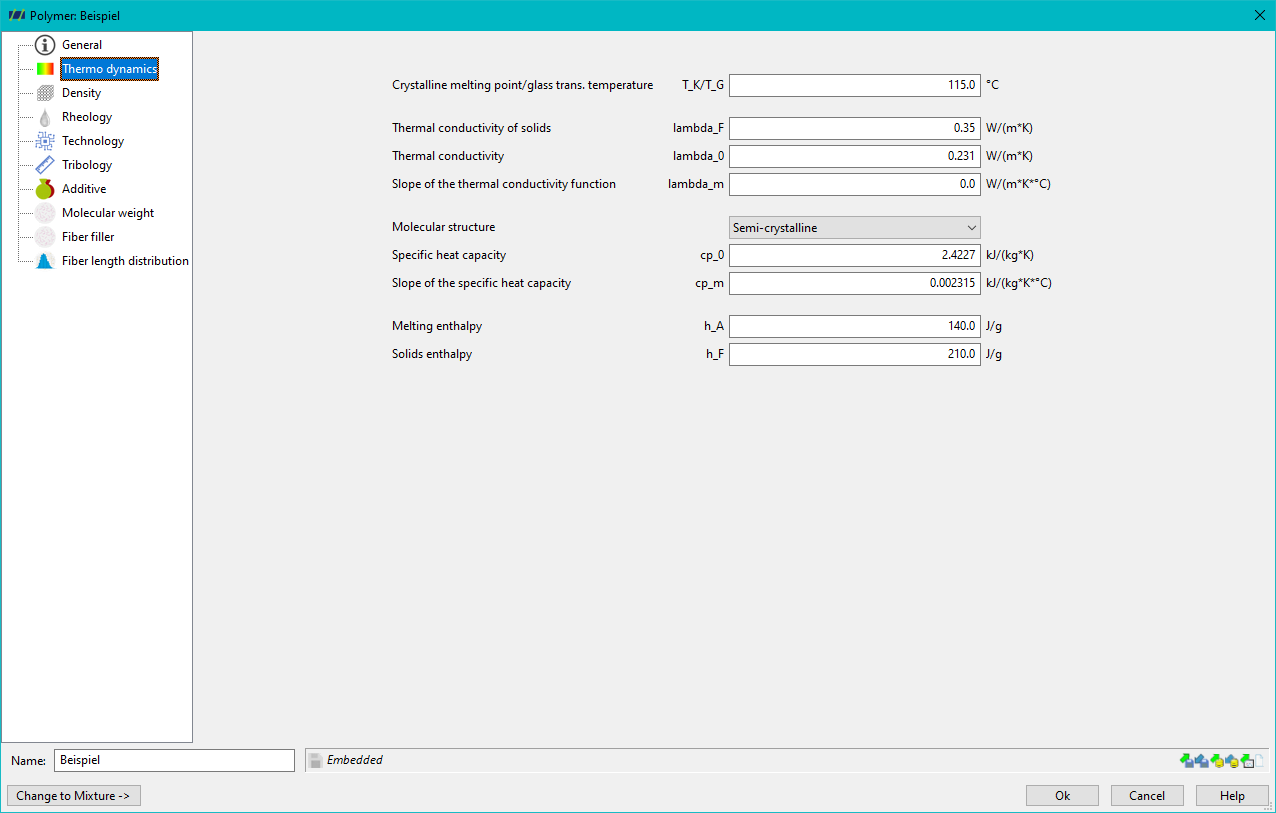
Specific Heat Capacity
The function curve of the specific heat capacity $c_p$ at ambient pressure for amorphous and semi-crystalline thermoplastics is shown in the following figure. In the melting range the specific heat capacity follows a virtually linear course and can thus be described by a straight-line equation:
\[c_p(T) = c_{p,0} + c_{p,m}\cdot T\]

Specific Enthalpy
The specific enthalpy results from the integral of the specific heat capacity $c_p (T)$ between the limits $T_1$ and $T_2$:
\[Δh = \int \limits_ {T_1}^{T_2} c_p(T)dT\]
Thus, one obtains the quantity of heat expressed in terms of the mass unit, which is required to increase the temperature of the polymer from $T_1$ to $T_2$. In case of amorphous materials, a steeper increase is seen in the temperature if the glass transition point $T_g$ is exceeded.
By contrast, semi-crystalline materials show a stepwise increase on account of the phase change. The additional quantity of heat is described as the melting enthalpy $∆h_A$. The following figure shows the specific enthalpy as a function of temperature.
With indicating amorphous thermoplastics the field for melting enthalpy is not editable. In case of semi-crystalline thermoplastics the increase in enthalpy $∆h$ is formed by an enthalpy increase of the solid material $∆h_F$ and the melting enthalpy $∆h_A$ :
Amorphous thermoplastics: \[∆h=∆h_F\]
Semi-crystalline thermoplastics: \[∆h=∆h_F+ ∆h_A\]

Thermal Conductivity
In the case of thermal conductivity, it is necessary to distinguish between steadystate and non-steady-state temperature fields. With steady-state temperature fields only the thermal conductivity $λ$ is available as a material value. This is temperature-dependent and higher for semi-crystalline materials than for amorphous ones.
\[λ(T) = λ_0 + λ_m \cdot T\]
$λ_0$ represents the value obtained from the straight line that describes the melt range at 0 degrees. The gradient for the thermal conductivity $λ_m$ can also be negative and must then be entered with a negative sign. The effective thermal conductivity of the solid is required for the melting calculation. In order to determine this value it is necessary to enter the thermal conductivity of the solid $λ_F$. The melting temperature $T_{k,g}$ must be entered in this mask. In the case of semi-crystalline materials this temperature is interpreted as the crystalline melting point $T_k$ and in case of amorphous polymers as the glass transition point $T_g$.
